
Search "how to make matcha," and you'll find a lot of rules, like which direction to whisk it in, how much water vs milk to use, and which sweetener is best (if you like to use any). All of this advice might make it seem that making matcha is complicated, but it isn’t.
If you can make an AeroPress, you can make a great cup of matcha.
And like coffee, the taste comes down to a handful of things — each of which are forgiving and easy to get right.
the leaf (and how it was grown)
freshness
water temperature
the amount of matcha used
how well it's whisked
and, of course, good MATCHA!
All it takes is a few simple steps, and you’ll have tasty matcha at home.
Part one: What matcha actually is (it's not just ground-up green tea)
Matcha is green tea ground into a powder. But you can't take a bag of green tea, dump it in a grinder, and call it matcha (and please don't put tea in your coffee grinder). Three things make it matcha.
It's shade-grown. For the last few weeks before harvest, farmers cover the plants to block most of the sun. The plant makes up for it by loading its leaves with chlorophyll (that deep green color) and L-theanine, an amino acid that tastes sweet and savory. Less sun also means less of the stuff that makes green tea bitter and astringent. It's a lot like processing on a coffee farm: decisions made months before it reaches you shape most of what ends up in your cup.
It's made from tencha. After harvest, the leaves are steamed and dried, and the stems and veins are then removed. What's left is the soft, flat part of the leaf (tencha).
It's stone-ground. Traditional matcha is milled slowly between granite stones into a powder way finer than any espresso grind. It's slow on purpose. Grinding fast creates heat, and heat dulls flavor (same reason we care about grinders that don't cook your coffee beans).
How is matcha different from regular green tea
With a tea bag, you steep the leaves before discarding them… so you're only drinking whatever the water pulled out, kind of like a pour-over. With matcha, you whisk the whole leaf into the water and drink it all, meaning no filter and no spent grounds.
That's why it tastes so much richer: thicker, sweeter, more savory, and greener than anything you'd steep. It's also why quality matters so much; there's nowhere for a bad leaf to hide.
Part two: How to spot quality matcha (ignore the word "ceremonial")
You'll see matcha sold as "ceremonial grade" and "culinary grade." Quick heads up: those aren't official terms. Nobody in Japan certifies them, so any brand can put "ceremonial" on any tin.
Roughly, "ceremonial" means it's meant for drinking straight, while "culinary" means it's meant for baking and blending. But the label alone won't tell you much.
But here’s some clues on how you can spot quality matcha;
Color. Good matcha is a bright, vivid green. Dull, yellowish, or brownish matcha comes from older leaves, more sun exposure, or oxidation from sitting around too long.
Smell. Open the tin. It should smell sweet, grassy, and a little like fresh-cut vegetables. If it smells like hay (or like nothing at all), that's a bad sign.
Texture. Rub a pinch between your fingers. It should feel silky.
Origin. Good matcha tells you where it's from, ideally down to the region or farm. Uji, Nishio, Kagoshima, and Yame are some of the best-known tea regions in Japan.
Price. Matcha takes a ton of hand labor, and it shows. A big bag for a few bucks is almost certainly low-grade leaf.
This is basically how we buy coffee, too. A named farm, a named region, and a fair price tend to show up together with a better cup. A coffee bag that just says "100% Arabica" tells you about as much as a matcha tin that just says "ceremonial grade."
Part three: The gear you need to make matcha (you don't need a whole tea set)
The traditional setup has four pieces:
Chasen: a bamboo whisk with dozens of thin prongs.
Chawan: a wide bowl that gives the whisk room to move.
Chashaku: a curved bamboo scoop. One heaping scoop is roughly a gram.
Sifter: a small fine-mesh strainer. Matcha clumps easily, and sifting is the easiest way to avoid lumps.
If you're coming from coffee, you probably already own half of what you need. The scale you use for pour-over beats a bamboo scoop for consistency. A gooseneck kettle with temperature control is perfect. A wide cereal bowl stands in for a chawan just fine, and a handheld milk frother works great, especially for lattes.
That said, if you buy one thing, buy the whisk. Nothing else foams matcha quite as well. We recommend this one.
One important note, we suggest using a bamboo whisk, opposed to a metal one. Bamboo possess natural antimicrobial and antifungal properties due to a bio-agent contained within the plant known as "bamboo kun." If you’re adding sweetener, don’t use the bamboo whisk to stir it in. Use the whisk to break down the matcha, then a spoon or metal whisk to mix in the sweetener (more on that below).
Part four: How to make hot or iced matcha
The one rule that matters most: don't use boiling water. I brew coffee at ~200°F, and that's exactly what you don't want here since matcha is more sensitive to heat. Aim for 160 to 175°F instead.
Quick note of comfort here, too: if your kettle doesn't have a temp setting, don't stress. Bring it to a boil, take the lid off, and let it sit for 6 to 7 minutes. That gets you in the neighborhood.
Hot matcha (usucha)
This is the traditional way to drink it, just matcha and water. Think of it like trying an espresso straight up before you add milk.
Add 3 grams of matcha into your sifter, placed over your bowl. (If you like a stronger taste, add a half gram each time and see what you like!)
Add a few splashes of the hot water, 25-35 grams or mL, just enough to make a watery paste, and behind to whisk vigorously with the bamboo whisk. This kills any lumps the sifter missed. As mentioned above, always use a bamboo whisk.
Keep going for 15 to 30 seconds, until there's a layer of fine, creamy foam on top with no big bubbles.
Whisk quickly in a zigzag "M" or "W" shape, moving from your wrist, not your arm. Circles just slosh it around.
If you want to add sweetener, do so now. We sweeten our matcha with 20 grams of honey, but you can use any type of sweetener you’d like. Don’t use the bamboo whisk to mix it in, as it could contaminate the antimicrobial properties of the bamboo whisk. Ideally you want to use a wooden spoon. But a metal spoon or whisk also works.
Add the rest of the water to taste. We suggest about 150 grams (about 5 oz) total.
Drink it right away. Matcha settles as it sits.
Without sweetener it should taste sweet, savory, and green, with a little pleasant bitterness on the finish.
Iced matcha
Same idea as our flash brew: make it hot and concentrated, then hit it with ice. Matcha doesn't mix well in cold water, so whisking it warm first keeps it smooth instead of clumpy.
Sift 3 grams of matcha into a bowl or mug.
Add your water at 160 to 175°F and whisk until smooth and foamy, same as above.
Fill a glass with ice and milk of choice (if you want specifics, start with 8 ounces and add more as you dial in your preferred taste).
Pour the matcha over the top and give it a quick stir.
Our matcha latte
This is the recipe we use at the bar, and it works hot or iced.
Ingredients
3 grams matcha
40 grams hot water
20 grams honey
10 oz of Milk, steamed or cold
Steps
Sift the matcha into a chawan.
Whisk with bamboo whisk until it's smooth and foamy with no clumps.
Add the water and honey, then stir with a metal whisk until everything is blended.
Hot: pour in steamed milk. Iced: fill a glass with ice and cold milk, then pour the matcha over the top.
The honey isn't just there for sweetness. It rounds out the grassy edge and makes the matcha taste fuller under the milk. Oat milk and whole milk both work great.
Part five: Adjusting your process
What should it taste like?
Good matcha should taste sweet, savory, smooth, and green. A little bitterness on the finish is normal. Harsh, chalky, or swampy is not.
If it's clumpy: you need to whisk it a bit more before adding more water or milk.
If it's bitter or harsh, your water is too hot or you used too much matcha relative to the water. Let the kettle cool longer, or add a little more water.
If it won't foam, whisk faster and in a zigzag, not in circles. Keep the whisk just under the surface toward the end. A proper whisking will yield a good layer of foam.
If it tastes flat or like hay: your matcha is probably old or oxidized (more on that below).
Same as coffee, we always recommend changing one thing at a time, starting with water temp, then the amount of matcha.
Storage
Matcha goes stale way faster than coffee beans. Think about how fast pre-ground coffee fades, then make it a powder finer than flour. That's a huge amount of surface area exposed to air, and matcha hates oxygen, light, heat, and moisture.
Always keep it refrigerated.
Keep it in its sealed tin, pressed shut. Ideally in a plastic bag, too.
You don’t need to freeze it, just keep it cool.
If your matcha has gone from bright green to olive, it's past its best. Use it for baking or smoothies instead.
Part six: The matcha we carry
We wanted the same thing from our matcha that we want from our coffee: a real person and a real place behind it.
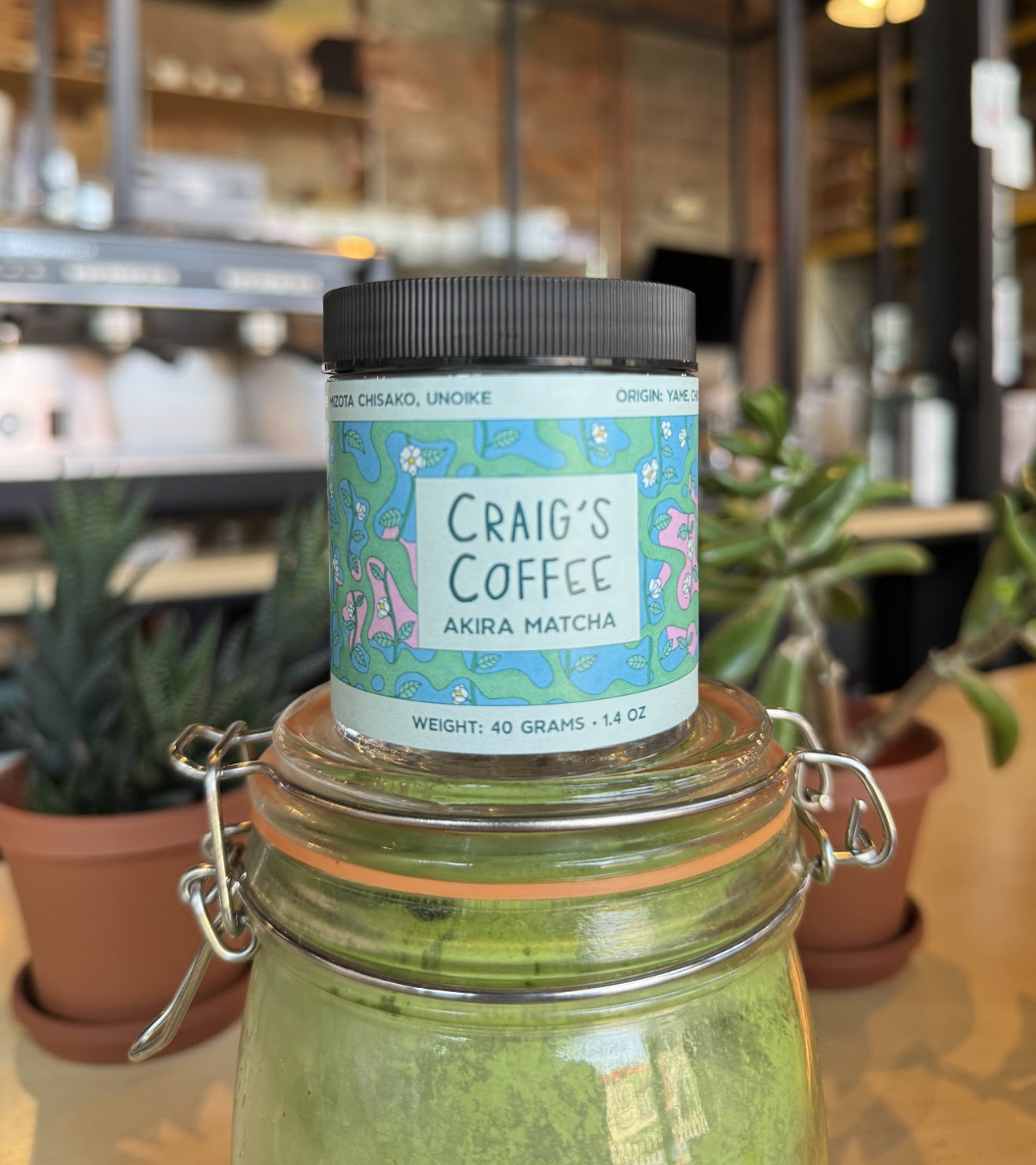
Our matcha is Akira Matcha, grown and produced by Mizota Chisako-san in Yame, in Japan's Fukuoka Prefecture. It comes to us through Noka Imports.
Mizota-san started farming green tea at 19 and has been at it ever since. She and her husband opened a small tea shop, and their tea became famous across Japan after he won the top prize at the All Japan Green Tea Competition. Today, her grandsons help carry the farm forward, and she still sells her tea.
Yame is one of Japan's most respected tea regions. Morning mist and river fog roll over the fields, which naturally shades the plants and pushes up those sweet amino acids from Part one. The region is known for tea with full body and real sweetness, and that's what we taste in Akira.
It's the same matcha we use for lattes at the bar, so if you like ours, you can make it exactly the same way at home.
Final thoughts
Matcha isn't the fussy, ceremonial thing the internet makes it out to be. It just plays by different rules than coffee: cooler water, a sift, a good whisk, and fresh powder.
Remember, flavor is subjective (like most foods). Go a little stronger, add more honey, try it iced. Whatever tastes best to you is the right way. And if you'd rather have someone else make it, stop by the bar at 412 Peterboro and we'll whisk one up for you.
