
Ethiopia Agaro, grown and produced by smallholding farmers of the Genji Challa community, at 2,100 to 2,280 meters in Oromia.
Meet the Gera G1: jasmine, bergamot, and peach, with a clean, tea-like body.
Most of what I bring in is here and gone. This one is sticking around: it'll be on the shelf for the next several months, which makes it the rare coffee you can actually get used to. And it earns that spot, because a washed Ethiopian is about as good as an everyday cup gets.
No single producer, just a few neighbors
It’s very common for producers in Ethiopia to combine their lots that harvest at the same time, depulp the same way, then use a shared processing station to ferment, wash, and dry their coffees. All of these producers are growing the same varieties, Ethiopian Landraces, or Heirloom, which is a term used for Ethiopian varieties. Without going too far down the rabbit hole, in Ethiopia, coffee has grown naturally for centuries, often alongside coffee that is intentionally cultivated on farms and in forest gardens. These wild and cultivated coffee populations can exchange genetic material over generations, creating an extraordinary amount of diversity from one region, or even one farm, to the next. Because many of these coffees aren’t neatly traceable to a single named variety, they’re often referred to as Ethiopian “landraces” or, more broadly, “heirloom” varieties.
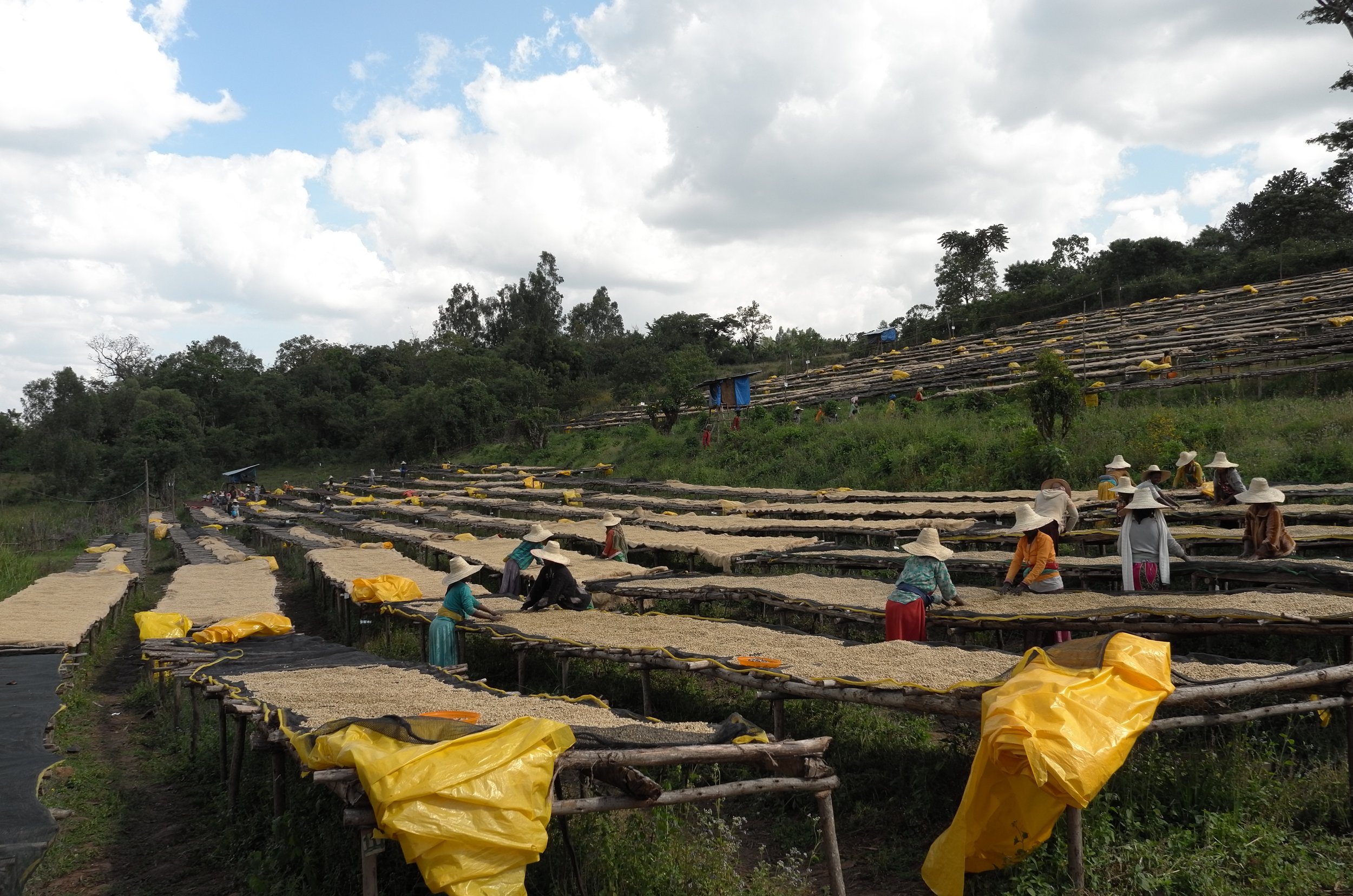
Gera G1 is a community lot, combining the work of smallholders across the Genji Challa kebele, in the Gera district of Djimma, Oromia. Farms here average between 0.1 and 2 hectares, meaning some of these plots are smaller than a Detroit residential lot.
They're also packed in close proximity to the washing station; most producers live within 20 minutes of it. During harvest, they bring their cherries to the nearest collection center by motorcycle, horse, or donkey along dirt paths that pick up where the paved roads end. From there, trucks haul everything to the central station.
The producers side of that trip is short. Ours isn't: fly to Addis Ababa, catch a 40-minute local flight to Djimma, then drive four hours to reach the station those motorcycles pull up to.
And because everyone delivers in cherry form, all of the pulping waste ends up in one place. The collection centers compost it and hand it back out to the producers as fertilizer, so one farm's pulp ends up feeding the next. The coffee is also intercropped with native shade trees, (including bananas) that feed the soil.
Why Gera still grows coffee instead of khat
A lot of Ethiopian coffee land has been converted to khat or eucalyptus over the last couple of decades, and both of those pull enormous amounts of water out of the ground.
Gera has mostly not gone that way. Coffee here needs the forest canopy to grow well, so growing coffee means keeping the forest. As long as this region keeps producing, those trees have a healthier, longer life.
What is washed process coffee?
I've spent two months talking about fermentation experiments… this is the opposite.
Washed processing is the “classic” method of coffee processing. The cherries are mechanically depulped, so all of the fruit is stripped off the bean before it ever starts drying. This lot then soaks overnight in clean water and dries on raised beds for six to eight days, elevated so air can move underneath. There’s no fruit left on the bean, nothing added to the tank, and no fermentation science experiment; a bit more straightforward.
Which means nothing gets built into the cup that wasn't already in the seed. What you taste is the bean itself: the variety, altitude, and soil. Every bit of what you taste has to already be in the seed. When a washed coffee is great, it's because the coffee is great.
Worth knowing as well: the "G1" is Ethiopia's top grade. The country sorts its coffee by how defects appear in a sample, and Grade 1 is the cleanest, most carefully sorted tier.
What makes the Ethiopian Agaro taste floral or tea like?
Two things, and a washed process, are why you can taste either of them in the first place.
Altitude. These farms sit between 2,100 and 2,280 meters, which is high even by Ethiopian standards. Cherries develop slowly up there… so the bean comes out denser, and the sugars and acidity end up more concentrated. That's where the sweetness and the structure come from.
Variety. Ethiopia is the birthplace of arabica, and what's growing here isn't a single named variety like June's Caturra. It's landrace: local, wild-descended populations that have been growing in these forests for a very long time, many of which have never been formally cataloged. That genetic jumble is why Ethiopian coffee tastes so distinctly like Ethiopian coffee, floral and tea-like in a way that's hard to find anywhere else.
The result is delicate and precise, showing what a bean tastes like when nothing has been added. That's also why it's earning a long stay on the shelf, it’s a coffee you can drink every morning for six months but never grow bored of it.
Tasting notes
Tasting Notes: Ripe Yuzu 🍋, Blood Orange 🍊, Jasmine Tea 🍵, Sweet Subtle Finish 🍈
Medium-light roast. The jasmine is the one to watch for; it sits behind the citrus rather than on top of it, and it's most obvious as the cup cools.
How to get Ethiopia Agaro (Gera G1)
The Gera G1 is available at the roastery and online, and if you want to try it before committing to a bag, it's on the menu as a pour-over and would be a solid AeroPress brew.
Come say hi to us (and Angus) while you're at it.
